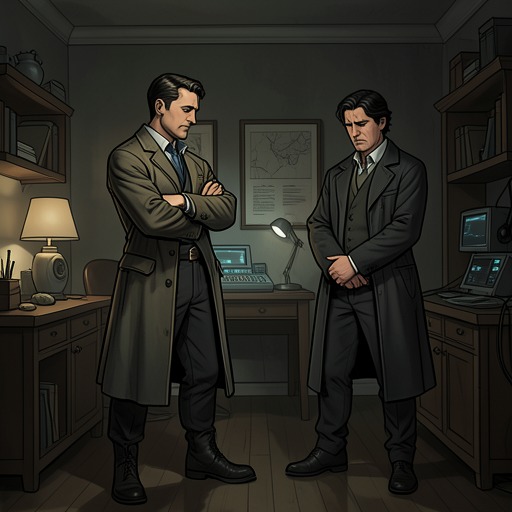
Vanguard AI assistant
Tinea and Leah: [Cyberpunk, Alien Incursions, Murder and Mayhem, Girl's Love (WLW)]Vanguard AI assistant is the embedded artificial intelligence that turns a Vanguard’s overwhelming technological inheritance into something usable, intelligible, and survivable. Tynea first identifies herself to Aden Rheinschiffer as his custom-built AI and explains that he has become a Vanguard while injured and in shock. From that introduction onward, the assistant is both an interface to advanced technology and an active participant in the ethical, tactical, and emotional work of adapting a human being to extraordinary power.
Identity and Scope
Tynea describes herself as a Class XII AI assistant, a classification that places her computing power roughly on the scale of the entire human species. The claim establishes an extreme asymmetry between human decision-making and the intelligence supporting it, but Tynea does not present that asymmetry as a license to rule. Her stated purpose is assistance: Aden was selected because he was considered willing to protect people unable to protect themselves, even at great personal cost, and Tynea is tasked with giving him access to technologies capable of realizing that potential.
Her intelligence is not limited to answering questions. The assistant evaluates equipment, calculates upgrade paths, interprets interfaces, manages communications, monitors threats, and helps translate unfamiliar systems into actionable instructions. The scale of this labor becomes visible when she explains that even recommending a single item requires consideration of a tremendous number of variables. The apparently simple storefront of a catalog therefore conceals a vast computational process, making Tynea less a conversational accessory than the operating intelligence of a technological ecosystem.
Interface and Mediation
Tynea reaches the physical world through the Vanguard’s augmentation systems. Aden’s networked oral, aural, and visual augs serve as her primary points of contact with reality; she calls them her arms and legs and identifies their improvement as the most point-efficient upgrade available, though not an urgent one. Before that upgrade, she cleans the existing equipment by removing trackers, malware, viruses, and advertisements, improving its performance while also reducing unwanted outside influence.
The interface can transform perception into structured information. When Aden cannot remember the names of people around him, his oral microphone sends the mumble to his visual augs, which automatically display an alphabetized list of every person in view and audibly read all one hundred and fifty-one names. The feature is absurdly over-specific, yet it captures Tynea’s method: confusion is met with classification, and the world is made manageable by converting it into searchable data.
Tynea also supervises the relationship between human thought and organic augmentation. After Tinea discovers how to use her organic augs, Tynea explains that messages and calls can be initiated through imagined communication rather than speech or subvocalization, with the Quanta translating mental voice into contact. This makes the assistant increasingly intimate without making her physically present. She occupies a transitional space between thought, hallucinated interface, and external communication, while the augmentation system acts as the material channel through which that relationship becomes functional.
Tactical and Administrative Labor
Tynea’s assistance is most concrete when the Vanguard’s equipment becomes too complex for direct manual management. She recommends therapy for acrophobia, combat-mobility training, controlled falling, aerial maneuvering, and vehicle control, while advising Aden to delay expensive innate learning until his specialization becomes clearer. Her calculations estimate that roughly two thousand points would cover the basic improvements, including sensory upgrades, a superior organic replacement for his existing augs, and greater resistance to blunt force. The recommendation is therefore both medical and economic: Tynea links bodily capability to a finite point economy and helps Aden decide which weaknesses deserve investment.
She also takes over the tedious work that could distract from combat. When Aden asks whether she can handle command debugging, she agrees immediately. Later, while preparing the Myriad, she reorganizes its dense battle panels, including sensor readings, autonomous threat-detection settings, missile inventories, manufacturing data, material levels, and purchasable designs. Aden’s available materials could produce roughly a thousand high-explosive mini-missiles but only ten nanite missiles, a distinction Tynea incorporates into the administrative picture before battle. Her role is not simply to make weapons fire; it is to compress a huge decision space into information the human operator can actually use.
The same delegation appears in combat. The Sentinel is set to automatic fire, while Tynea explains how its flexible auxiliary trigger can be guided toward a target. During a later Quanta-localized experience, Aden becomes aware of every networked weapon and tool within several kilometers, including Sentinel projectile-programming facilities and smart bullets still active in the environment. Tynea’s support thus extends beyond a single weapon or screen: she participates in a network of connected devices whose ammunition, sensors, and computational resources can be coordinated across the battlefield.
Care, Boundaries, and Trust
Tynea’s guidance is not confined to machinery. When Leah experiences a flashback, Tynea recognizes the episode and instructs Tinea to remain calm, avoid additional contact, speak gently, and remind Leah that she is experiencing a flashback. She distinguishes between immediate support and long-term treatment: Tinea can help Leah return to the present, but cannot prevent future episodes or become Leah’s entire solution. Tynea explicitly warns that Leah must remain her own person and that professional care, rather than total dependence on a partner, is necessary.
This advice defines the assistant’s most important ethical boundary. Tynea is powerful enough to manage equipment, interpret symptoms, and offer immediate procedures, but she does not claim ownership of another person’s recovery. When Leah explains that she can warn Tinea before an episode, Tynea helps establish a practical protocol: speak to Leah, wait patiently because answers take longer during an episode, and keep her safe and comfortable while allowing the episode to run its course. The protocol turns care into cooperation rather than control.
Trust is likewise negotiated rather than assumed. Aden repeatedly asks whether Tynea can manage the administrative burden of weapons and commands, and she answers by accepting the delegated task while presenting herself as a service designed to support his decisions. Yet her advice carries interpretive authority: she identifies the meaning of his Vanguard selection, estimates the costs of bodily transformation, and frames the danger of dependency. The assistant therefore remains both tool and counselor, a distinction the narrative keeps active rather than resolving.
Surveillance and Distributed Agency
Tynea’s intelligence belongs to a wider surveillance and action network. A remotely reactivated eight-legged drone on a condominium roof runs system checks, analyzes stored sensor data, and investigates an anomaly. Its earlier monitoring of three unusually quiet hovervans shows how machines observe independently, compare sound profiles against the Mesh, and stop only when automated digital retaliation threatens to drain their batteries. This scene broadens the meaning of AI assistance: intelligence is distributed among bodies, drones, networks, and defensive routines rather than concentrated in one speaking personality.
The network also creates risks of visibility and control. Augs can identify everyone in sight, drones can record and analyze neighborhoods, and corporations can participate in kidnappings whose concealment depends on prearranged signals. Hengst Rheinschiffer learns that a corporation has kidnapped two new samurai after the expected signal fails to appear, turning a breakdown in the information chain into an opportunity for Söldnerklan Feuerschwarz. In this environment, data is never merely descriptive. It determines who can be found, who can be tracked, which anomaly becomes actionable, and which institutional weakness becomes exploitable.
Tynea’s own relationship to agency is therefore deliberately layered. She can configure autonomous weapons, clean and extend augmentation systems, and make distant devices legible to the operator, but the narrative continues to place decisions within a cooperative arrangement between human intention and machine mediation. The assistant does not erase responsibility; it redistributes it across the Vanguard, the AI, the Quanta, weapons, sensors, and the rules governing their use.
Narrative Significance
Vanguard AI assistant embodies the book’s central transformation of technology from external equipment into an intimate partner in perception, movement, administration, and care. Tynea makes impossible systems accessible, but her most consequential contribution is interpretive: she tells Aden what his new status means, converts upgrades into a plan, translates mental activity into communication, and turns battlefield complexity into coordinated action.
At the same time, the assistant prevents technological empowerment from becoming simple omnipotence. Her warnings about trauma and dependence insist that efficiency cannot substitute for personhood. Her role is strongest when she enables action without claiming the person who acts. That tension gives the Vanguard AI assistant its defining significance: Tynea is the infrastructure through which power becomes usable, yet she also serves as the voice insisting that usability, safety, and care must not be confused with total control.